
Bloodlines and Punchlines
Episode 07 | What if the only way you could live was for someone else to die? John Faherty talks culture, creation, and what he owes a woman he'll never meet


Not just someone else. Someone young, someone healthy, someone in the prime of her life. A mother, in fact, with four kids. A mom who was balancing different jobs. A mom you could never meet.
Today, John Faherty is Executive Director of Cincinnati’s Mercantile Library, a jewel of an institution, whose gala dinner is affectionally called “nerd prom.” (This year, Colson Whitehead’s headlining.) Just last month, Kaveh Akbar spoke at the Mercantile, introduced by the renowned Hanif Abdurraqib—an Ohioan himself. Located on Walnut Street, in a building that brings to mind a venerable university (or, sure, Hogwarts), the Mercantile is thriving under John’s leadership.
He’s every bit the fit: Well-read, witty, charming, a warm and wonderful presence. Though, as he cheerfully admits, he’s no idea how he landed in such a lovely place.
On the worth of books and culture and community alone, this episode was special. A love letter to Cincinnati.
Except that it’s heavier still, with a crisis that confounds, an outcome that we can’t wrap our heads entirely around. Years ago, John learned his pancreas was dying (and him, too). He needed a transplant. That in turn would mean someone else would have to die. What do we owe the people without whom our lives wouldn’t continue? What does it mean to live with God and gratitude, death and resurrection?
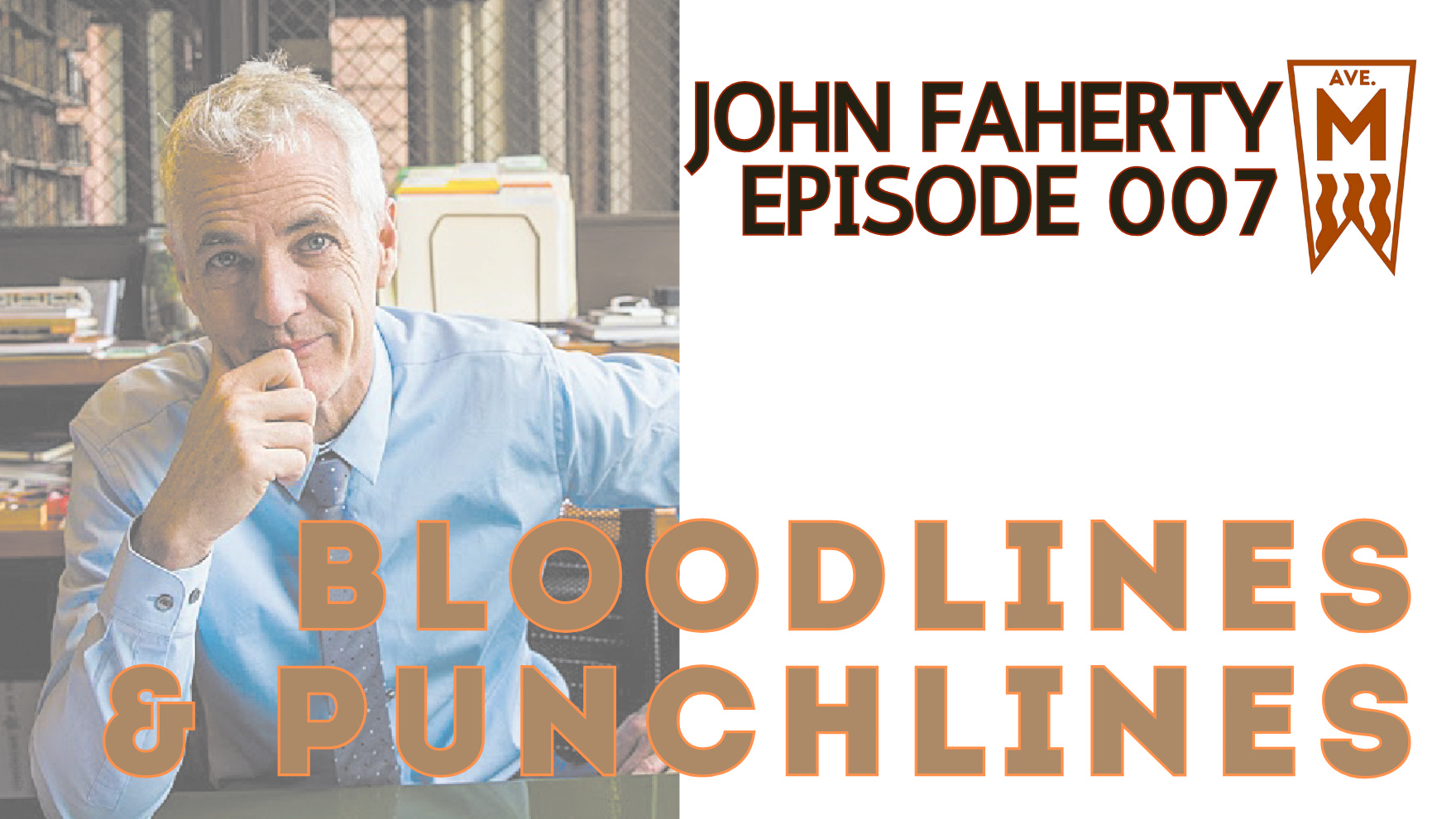
In our seventh episode, we touch on everything we love and care about: faith, parenting, marriage, books, responsibility, gratitude, and comedy. We even talk about things that some of us don’t care for: chili, despite Cincinnati chili’s Levantine roots. And it’s a well-timed episode too: in a particularly heavy few weeks for America, John asks what our institutions owe our country and moots how a space that leans left can speak to this moment. For those who’ve never been to Cincinnati, a visit to the Mercantile should be a priority. But for all of us, there’s a lesson.
Even the most interesting people we know have been through more than we might imagine.
Checking Out The Librarians
Of course, you can watch the full episode on our YouTube channel
You can also find the episode on Apple Podcasts and on Spotify (as well as other major platforms!)
We have teasers, trailers and sneak peeks on our Instagram (@AvenueMPod), X (@AvenueMPod) and Facebook pages. However you got here, thanks for listening! We hope you like, subscribe, and follow.
In the weeks ahead, we’ve got a man who works at the cutting-edge of AI and finance, an actor and comedian and kind-of, sort-of a cleric, and a remarkable new American historian, who’s behind a brilliant biography of the abolitionist Charles Sumner.
We hope that’s incentive enough to get you to
We’re Avenue M: Haroon Moghul (Sunday Schooled) and Joey Taylor (Bespoken Live), two Midwestern men exploring faith, meaning, parenting and so much more.
The Show Notes
John Faherty’s the Executive Director of the Mercantile Library—which we encourage all Cincinnatians (and tri-staters) to check out, support, and spend time in. In eras like ours, the need for thoughtful spaces where people of different persuasions can come together is necessary, proper, and genuinely patriotic.
This year’s Niehoff Lecture, the Library’s annual gala, features Colson Whitehead. Tickets are still available.
Faherty himself wrote the story about his organ transplant for the Cincinnati Enquirer.
This week’s episode is the first to be sponsored by The Brueggeman Center for Dialogue at Cincinnati’s Xavier University. Dedicated to deepening understanding across faiths and promoting systemic change, the Center hosts thoughtful conversations about religion, reason, and so much more—visit their website for more information. We’re honored by this support, of course, especially because it’s a sign of our commitment to Cincinnati and Ohio.
Avenue M is produced by Bespoken Live with music by Zach Swelber, who plays in Circle It and Mosant.
Transcript
The below transcript was generated by AI. It has not been reviewed for errors.
John: Are you from Cincinnati? I'm not from Cincinnati. I have lived here I think about 13 years. And I love it, but I grew up in Chicago and Massachusetts. So what brought you to Cincinnati? I think the same is literally every other person I've met, their wife got a job. So I was a trailing spouse. I came to work at the newspaper at the, uh, Cincinnati Enquirer where I was for about, about four years.
And I've been at the library ever since, but came for work. But I feel kind of Midwestern, so my parents at the time were aging. Only one is still aging, so it just felt good to get back to the Midwest.
Joey: I was gonna say, have you ever considered leaving Cincinnati since you, since you've moved here?
John: I love it here. I made good friends. I got a cool job. I am no longer a trailing spouse because I am no longer married to that spouse, and I am married to a Cincinnati native you know, whose mom and dad are here, and who, like, we each have children here. So I think I'm pretty rooted.
Haroon: I guess I want to ask this question 'cause for people listening, cincinnati's often a blank space in people's minds maybe just generically gets lumped in the Midwest. So if you've never thought about leaving, what is it about Cincinnati that you find? I mean, and in fairness, you have a very cool job, which we will talk about.
It's genuinely a fascinating role. A but beyond that,
John: beyond that I really like the size of it. You know, I ride my, I rode my bike into work and back yesterday. That's like a five mile bike ride, which is just really pleasant. I like that this city's big enough that I still haven't been to all the restaurants I wanna go to.
I'm not super cultured, but I know there's a really good opera in ballet and symphony and all that stuff. But it's also small enough that like, I feel like you can kind of make a difference in this city. You can, if you wanna get involved in your, in your earnest I feel like it's a city that you could still make a difference.
You can make a change. You can, um, it's an accessible city.
Joey: love that answer. A place where you can make a difference. For people who are transplants, like the three of us are here in Cincinnati, do you have any advice for them? when their intention is to put down roots personally, professionally, what would you advise them?
John: I mean, I think we, I'm not sure if you guys were, how long you've been here, but there was this big debate, I dunno, maybe seven or eight years ago, about is Cincinnati welcoming to strangers? And a lot of people fell on the line of, no, it's polite, but it's not welcoming. Which I presume that's 'cause of all the Germans. I'm, I'm glad you said that. Certainly well mannered. Yeah. I'm here to say what needs to be said or shouldn't be said. I mean, this is like trite advice, but like, just be sincere. just try it. Just, if you wanna be here, just like actually try it, it, I didn't eat chili for like, the first seven or eight years that I got here.
'cause I was like, I'm, that's not chili, that's not spaghetti. Eddie. I am too good for Skyline.
Haroon: Okay. So can you, can you tell folks what are you talking about when you're talking about chili? Because a lot of folks might not know that. Cincinnati. Oh, all right. So PHIMS or Chili,
John: it has this well-known delicacy kind of a food of, of mixed origin. It's got some Lebanese influences and it's like, it's called chili, but it's, it's served on standard spaghetti as a rule. And then with chili on it and this mound of this brick of cheese. And I just thought that's, and it's not chili like, like you would think of as like a big bowl of chili.
And it's certainly not spaghetti. it's kind of a mix and it's really peculiar and it's cheap and you look down your nose at it and then your kids convince you to go have a bowl. And you're, and you're like, you think, why did I spend five or seven years not eating? We're not trying this, this is so stupid.
I should have tried it. And liked it a long time ago. It's, it's, it's, it's kind of a story of Cincinnati
Haroon: one. I didn't know that there was a Lebanese connection. I think he's
Joey: lying about that. Har, I think, no, he's not more, more cultural.
Haroon: I feel like John knows a lot about things.
John: I, there it was middle Eastern people sometimes get into the restaurant industry, especially like places that they could open up as immigrants, like quickly and affordably, and this fits right into that.
And so, yeah, they brought some of their own spices with them and, and you know, hold on. It's not, it's Jordan, Jordan, Lebanon. Oh, shoot.
Haroon: Now you're just saying they're all kind of the same. Is that, what, is that what's happening? Hey.
John: No, I think it's Lebanon.
Haroon: Okay. Is it Lebanon, Ohio or Lebanon in the country?
John: It's definitely Jordanian.
Joey: Oh boy. Taking on our different countries. Well, at least we were talking to a librarian about, you know, facts. That's good. Thank God. I am,
John: I am, um, knowledgeable to a fault, I'd say.
Haroon: Well, I was I'll I'll tell you. So you've been here 13 years? I've been here five years. I mean a lot like you, my wife grew up here and so we moved here during COVID. I did not know what to expect. Uh, I have to be honest, there was quite a fair bit of trepidation, but I've come to really like it. And I think one of the things that, I mean, there is sometimes a kind of insularity and parochialism that I find a little bit difficult.
But at the same time, I also feel like there's an openness and a sincerity and there's ambition. It's just very different. And I, and I think one thing that, that definitely struck me, and I'll be totally honest, 'cause I came out of, I grew up in the New England, uh, area, then New York for a long time, and I did have a kind of, I looked at the Midwest, like you, John looked at Chile, right?
So it was kind of like, why, you know, this doesn't, the gainfully Yes, exactly right. Like, is it gonna gimme a stomach ache? That was basically, that was, that was the arc of it. But I, I, I do think, actually, and it's a weird thing to say in this moment, I feel like people are more open and welcoming in many respects here than I did find in many places on the East Coast.
And I often found that conversations across cultures and religion and race are often actually a lot easier and a lot warmer here than they were in many other places. It sounds kind of strange, I dunno if you feel like this Joey, but I feel like I can be more myself here in many respects than I, I could be in a place like New York, certainly Washington, DC where there's a lot of pretense about embracing and accepting, but not a lot of follow through.
Joey: John says it. Do you agree with that, John? What do you think?
John: Yeah, I totally agree with that. I had a distinct advantage. I moved here as a newspaper reporter, and all I did was talk to people. I had this kind of silly beat when I first moved here. The editors said I wanted to talk to people who were doing interesting things. Well, it was amazing. And it had like, it had this stupid name.
Now you can't remember. I was like, oh my God, what have I done? I, I'm in Cincinnati, Ohio writing for this paper that's smaller than the paper I left writing like, like newsmakers and. she was a hundred percent right. It was just people doing interesting stuff and like, so I met everybody.
I was writing, you know, five stories a week on this. So I, I met everybody in this city in the first four years, I think. And it just turned out to be, I, I, I agree with Haroon. Like these people will welcome you into their homes. Haroon’s been to my home, I've been to his and you know, we just met at the library,
Haroon: I think, right?
The library. Yeah. I, I, I think that's where we met at, at Mercantile Library. To be clear, that's where you do very cool things. That's, I get over the library. The library. I, my apologies if you are in Yeah. It's sort of like in New York, they just call it the city, you know, it's, there's no other city. Right.
So in Cincinnati there's, but here the problem is people listening might think that there's actually no other libraries in Cincinnati. Correct? Well, there's a
John: huge and wonderful library system, public library system in Cincinnati. One of the, one of the best in the country.
Haroon: So I, I guess I'll ask this.
I know Joey has a question, but I'm gonna, I'm gonna beg your permission, Joey, and just ask how the heck did you end up running the Mercantile Library, which is, I believe what, like 190 years old or something like that?
John: 190 years old this week? This week, uh, last week, this month. Fair enough. This month.
Fair enough. Yeah. Recently as re we are this year. This year we're 90 years old. As, as approximate as Jordan, it's the Lebanon.
Haroon: Okay.
John: Are you allowed to swear on this program? Are, are you or am I? You are, you are, of course. Go ahead. I have to tell you, I still have no idea how I got that job. It's the coolest job in the world. All right, so just, I work at this place called the Mercantil Library, which was created in 1835 because at the time there were no public libraries.
The idea of public libraries in this country did not exist or other countries largely. So 45 businessmen formed the Mercantile Library because they thought, and it was such a great way to form a library, they thought we are just as smart as those rich guys. These were merchants, they were shop owners, and it was like the birth of the American middle class.
Never before had people who weren't born into money. Had money. It was the first time ever. It used to be you were born rich, you stayed rich. That your fate. If you were born poor, you stayed poor. That was your fate. And it was, you know, as true then as it is now. But for a brief window in the 1830s, poor people could rise up and open their own shops and become wealthy and have time on their hands for the first time.
And they formed a library, which is just such a great thing to do. They wanted to we are still trying to live up to, I guess what would be their mission statement in 1835, which was to democratize knowledge. And we still exist today because. 10 years into our existence, the building burned to the ground twice in a short window.
And then the building owner said, we're out, we quit. We don't wanna be building owners anymore, we're losing our shirts. And the library members in 1845 came up with $10,000 in a very short order, like a week, and gave it to the building owners and said, this is a gift. Please build your building with this money.
And all we want in return for these $10,000 is a 10,000 year lease. And I think the building owners thought they were like, they were like, who are these clowns? They're giving us 10,000 bucks and all they want is a place for their books. Well, now we're like, we're year 180. Of our 10,000 year lease, which we pay a dollar a year, which we paid up front.
So we are rent free. Which allows us to be a spectacular library, allows us to bring in incredible authors. The job for the director came open and because I'm an idiot, I thought, oh, I'm gonna apply for that job. Nobody's gonna want that job. Of course they'll hire me and I gotta get outta print, I gotta get outta journalism. It's going away. It's getting sadder and sadder and newsprint is getting, the paper's getting smaller and the staff is getting smaller.
So I thought, oh, I'll apply for that job. This is great. The valuable lesson that I learned, this is an inflection point, is I applied for the job because I didn't think anyone would want it. 'cause I thought, this isn't that great of a job. Well, had I known how great of a job it was and had I known how many people were in fact going to apply for it, and it was well over a hundred, I would not have applied.
And like that's the lesson I learned. Like I would've said no to myself instead of giving them a chance to say no to me. And then those fools never got around to saying no to me. So I've had the job now for like 10 years and I've actually, I think been pretty good at it. That was like it, honestly, it was such a valuable life lesson for me.
It was, how many times do we say no to ourselves? Because we think, oh, that won't happen. I mean, I have a lot of confidence. It's not like I thought I wasn't good enough. Yeah. I think I put enough on anything, but I thought, no way, on God's green Earth, I'm gonna get that job and I wouldn't have applied.
And I did, and I got it. So that was my inflection point.
Haroon: So you say they, they took a chance. Do you, do you think they took a chance on you or you took a chance on yourself?
John: I think they took a chance on me. I mean, I wasn't a librarian. I have never worked in a library. I had a little free library in front of my house.
That was, did you bring that up in, did you bring that up in the interview? Yes, I mentioned that as part of my experience. Like I have a bookshelf, you know, it is a very well curated little free library. So I'd say they definitely took a chance on me. I think they thought he's from Cincinnati.
He's gotta be the best candidate.
Joey: I have a question about your, about your role as the curator of the, of the library. Kinda going back to this idea of the Midwest.
Do you think there's a particular kind of emotional or creative tone, um, that you're trying to hit on when you're curating different, amazing speakers you're bringing in, you're, you're thinking about the books that you're wanting to feature, that that kind of thing.
John: That's a great question.
I don't think so. I think there is a Midwestern reader probably. it's kind of a no bullshit reader. Like, just tell me a story. don't sprinkle a few sentence in there. Ee Cummings. How about some periods and some commas, just like, like, why are you making this so hard? what do you guys think?
Joey: Do you think there is a Midwestern reader? I was thinking more of like the, kind of like the cultural situatedness of the city in terms of, not just the reader, what their expectations are, but the larger kind of cultural environment.
what you're hitting on makes some sense to me more direct, less kind of superfluous. That makes some sense to me. I think. there's a feature here that hits on some of those hospitality themes as well. There's a warmth and approachability to the, to the culture, to the art forms.
that's me kind of shooting from the hip. Harin, what do you think?
Haroon: I'm gonna make an analogy to airports you know, when you land in an airport, the airports I love the most are the ones where I feel like I have a sense of where I've landed.
Do you know what I mean? Right. like the airport looks like the place I'm in. Maybe it challenges me, surprises me, but it feels like it belongs in this place. And I do think that, I guess the way I see it is, I, I don't necessarily see it in, in the authors you invite. I don't mean that in a, in a negative way.
I mean, when I go to Mercantile Library event, I feel the culture of Cincinnati and the Midwest and the questions and the people and the responses and the energy in the room, the ways in which people pick up on certain themes and don't pick up on certain themes. And maybe it's just, it's coming from, you know, you've had some amazing authors and, and creatives come in and on a number of occasions I've been really surprised by how they've been received and the types of questions they get.
And I think to myself. And I think we all just do this, say, you know, would I have heard this question in New York or Chicago? It's not that the question is better or worse, it's just different. So I guess I, I always feel like I find, uh, a culture or an energy at Mercantile and in Cincinnati institutions, it's really unique.
I don't know what I would, how I would describe it though. I mean, maybe the, the no bullshit thing is, is part of it. I think there's also a warmth, there's a, a willingness to take a person as a person. There's uh, a kind of leveling effect. Like there's not a halo around the author. Um, there's not a self, there's no self-congratulatory tone.
Like, aren't we so cool? 'cause we're at a book of event and, you know, now we can justify to ourselves why we spend $8,000 a month in rent. You know, that kind of thing. Um, You know, which I, I think you get a lot of in certain places. But I guess what I would, so I would actually kick it back and I would say Do you ever think about how people would respond in a peculiarly like Cincinnati Way or Midwestern way? When you, when you think about an author, when you say, Hey, we should bring her in. We should bring this person in. Oh, this is what Cincinnati needs. Like, how do you frame that decision? I
John: mean, I, I could tell you that the authors who come to the events and, you know, authors kind of do events for a living sometimes they speak invariably about what a great audience it was.
And they all mention like, I think they've read the book and you're like, it's so great. I'm like, oh yeah, no. I promise you, they read the book, they did their homework. they were going to this event on Thursday night, so the Thursday before they picked up the book and they read it. And authors love it.
I mean, they like, they go, all we get, I got a handwritten note from Timothy Egan who was here last week, and it was just like this really thoughtful note about what an incredible experience he had. And it had nothing to do with me. It had to do with the library and, and the audience for his event.
And you know, midway, like, one of the things I like about Cincinnati, it used to drive me nuts, but I've grown to love it. Is like Cincinnati loves, like, still has a little bit of a, and it's diminishing, but a little bit of a, of an inferiority complex like. A lot of times these people who come to an event are so happy that this person chose to come to Cincinnati.
They're like, they came here. they used to drive me nuts. I'm like, of course they came here. This is, this is a great place. But it does make people a little warmer and a little sweeter. The authors love it, but we do, I think, you know, like a lot of people I've been focused a lot on you know, diversifying.
When you ask like, what are we thinking about when we're bringing in authors? we haven't done a great job historically diversifying our membership. We haven't done a great job diversifying who we bring in. I think we always thought we should bring in the best writers. And we brought in remarkable writers, but they all looked a lot alike.
And, were we ringing in the best white authors or were we bringing in the best authors? And there's two very different groups. So we have definitely, and, and I think this city will benefit from that, benefit from hearing more diverse voices in an elevated platform like the library. I think it's important and I think we can do it and we should do it, and people are happy that we do it.
Joey: I gotta, I gotta heavy hitter question. All right. Harun? Yeah, go ahead. who's the one author that you brought in that you would like to punch in the face? I'm just joking. Uh, what I, what I was really, what I'm really, oh, no, wait.
Haroon: Let's, let's see if he's willing to answer. I don't, I don't.
It's just, you know, maybe he will and maybe he won't. What was that? You said before you hit record, you just like to charge forward, forge ahead. You like to
John: forge hand? No, I, no punch. I mean, maybe
Haroon: not assault,
John: assault verbally. Verbally. No. I think it like, I think routinely in terms of like, that person has a very punchable face.
There, no, the short answer is no. There are some. We have done a better, there are a fair number of people who became writers because they have awful personalities. Nobody likes 'em. And they don't like other people either, so it works. They might not like themselves
Haroon: either. Yeah.
John: Yeah. There's so much loathing, so they just sit at their desk all alone, typing away, just banging out words like, karun, you know, somebody's gonna love me.
Haroon: I think when you reach middle age, you no longer really care if you're loved. I think that's, that's the trick that nobody told you about. Um, no, no. I, so I have a spin on this 'cause I, I actually think it's a really interesting question. I wanna go back to what I, I was saying earlier about I, I feel Cincinnati, the way in which I see people respond.
So I guess I'll take Joey's question since I know John, you're gonna be too polite and also you have a kind of vested interest in not doing that. have there any, have there been any authors or guests the reaction to whom surprised you that maybe they didn't land or the audience didn't connect with them, or, or maybe the audience did connect in ways you didn't expect?
John: I'm not sure if this is an answer to your question, but it's an answer to a question. Fair. Uh, we brought in, and this is like three years into my tenure, we brought in Chuck D and
yeah, I think he's one of the most important musicians of the last 50 years easily. His lyrics are remarkable. He's, I thought like we had planted our flag. We had said this is a different, the market deal library is now a different place. we are bringing in Chuck D we are fighting the power now, God dammit.
And we had like 500 people sign up. We had to move it out of our location to a, to the, to the Freedom Center. And I was so proud of us. I was like, this is it. We have, we've arrived. And then I got up to the microphone to introduce him, and I looked out at the audience, and if there were 10 people of color in the audience, that was all of them.
I realized, wow, we haven't arrived. A lot of people like Chuck D you know, there was a lot of suburban kids listening to Chuck d driving their parents, Volvos really loud. So it was such a valuable lesson. I was like, okay, we're having the right conversations with the wrong people.
So we have to, we have to have more conversations with more people. and he was amazing. And the audience. Loved him, and I was so proud of the audience for being there. And he was just, it was a, it was an incredible night, but it was, it was, it was the night I'd learned how far we have to go. Like, I'm not sure the black community in Cincinnati knew he was there.
That's how isolated we had become, how like siloed this institution was. And it was, it was a screaming wake up call for a very successful event. it was a remarkable event, but, um, we needed to do better. And, and, and we have.
Joey: Yeah, I mean, I appreciate Public Enemy as much as your random suburban white kid driving to Volvo, so I I totally get that.
Good art attracts a bunch of people. Right? Right. The one thing that resonate with me there is your insistence on having the right conversation with the right people. As you think about this moment that we're living in right now, do you have any sense of what the right conversation is and who the right people are to have it with?
I spent a lot of time thinking about
John: it and the first smart thought that comes across my head, I promise to let you know, I'll have my own podcast. John's, John's big idea, or John's idea? John's one. Good idea. I think we need to be, I mean, I'm like everyone else. I like, You know, my lovely wife, like a couple weeks ago, she was like, I said, how are you doing?
Well, I learned a valuable lesson. Never asked that question again. She started crying about the, the state of affairs. And
I think it was reasonable. I had been using up the last drops of my white privilege by just ignoring as much of this as I possibly can because I have that right? I have that luxury, not that right? I have that luxury. But that's not helping anybody. These, these are difficult times, these are trying times. We do need to talk about it and we do need to talk to each other. you know, I go back and forth, kind of like, I think a lot of the people sometimes I think, but this is the end. This country won't recover. We're becoming two countries that can't talk to each other.
We don't disagree anymore. I have to wanna stab you in the heart because you, you are un-American. Just because we disagree on policy, which is absurd. And so, but every time I think we're at the end of the rope. You know, we had a civil war. had in my lifetime. Probably not in your lifetime, but we had, we had college kids being shot by soldiers on their campus in Ohio.
So we have been in very dark places. And I think we thought certainly in that period, those sixties and seventies, the establishment thought that those kids were radical and they were some, you know, there was a lot of bombings taking place at that time in this country. Which we've just kind of forgotten about.
We like, oh, 68. Yeah. Those race riots. That, but that was forever ago. Well, what, it wasn't forever ago. those people are voting for Donald Trump today. Like. we've been down roads of us not liking each other before.
Joey: Yeah, I hear you. I, I, I heard you say in an interview in 2019 that the library particularly is a place kind of away from that polarized discourse, a place where you can have disagreement and come together where you don't have to make everybody you disagree with into your enemy.
I wonder how, like you said that in 2019, I'm pretty sure six years later, the discourse has only gotten more polarized, more difficult. How do you see the role of, of your work, your, of the library right now as it relates to, to the conversation that needs to be had?
John: Fuck 'em. They're on their own now.
No, I think I do think we have actually, I think we have. We have a moral obligation to be a place where people can come and disagree with each other. This calendar year in 2025, I'm gonna start a debate program where we we picked the right subjects, we pick the right people to debate and we just say and, and we pick subjects that like people can change their minds.
We're not gonna debate abortion. No one's changing their mind at the Mercantile Library about that. But I think we can be a pla We can be a place where we can not only disagree with each other, but we can learn from each other. I mean, it's just, it's, it, it's a magical place. Like people come in and it's, it's, it's almost reverential like a church.
Like you get quiet, you look up, you look around, you start speaking in HUD tones and you, you see like this, it's just like, there's a lot of markers that say you're in a special place. And we have all been trained from like a young age. We love the library it's, we, we go for story time and it's just like everything's lovely about the library.
And so I think a library has a huge obligation. That's a gift we've been given and we shouldn't waste it. The world needs discourse. Maybe not more than ever before, but as much as ever before and we're like, you know, we're a cultural institution.
We lean left. We do. I know we do. Um, we've been called out on it. So I don't want us to be part of
Haroon: the problem. so you're saying you, you know, you, you lean left and I'm, I'm sorry to cut you off, but I think there's something really interesting there that you, you touched on that I really want to spend a a little bit of time with is libraries do create a sense of transcendence, whether that's in, in the physical, the way a space looks, the way it's designed.
And I think those things are often discounted, uh, which is why, you know, cookie cutter settings sometimes don't really. Propel us forward, but also in terms of what they contain knowledge, a sense of connection to the past. And I'm wondering for you, you know, and I know you and I have talked separately and, and I think certainly all of us I think have talked about religion and faith.
Do you feel like there's a sense of transcendence for you, whether in this moment or more broadly? Uh, a connection to religion? I mean, Cincinnati is certainly a place where religion plays, uh, a very important role historically and presently. you let that come into your work at the library or is it something that you feel you have to, to keep separate?
John: I don't know how you would keep it separate. Right. I mean, it's faith. I've been thinking about it a ton recently because I grew up Catholic. And so for Lent this year I went to a different. Place of worship every Sunday. So I went to, Presbyterian, you know, just kind of dipped my toes in the water.
I don't wanna go crazy. Then, um,
Haroon: keep in mind you're talking to a Muslim, so I'm not actually sure if Presbyterians are crazy now. So I feel like I'm, I've also got myself in trouble saying that, but you know, just remember, I have no idea what's happening with people.
John: I can tell you they're as crazy, but they're not as good at dancers.
Um, so Presbyterians Catholic, I had to go to a, like, non-denominational place at my, where my mother lives. I went to a Dharma, I went to, a Quaker house for, and, and I went to, um, crossroads at the end. And so I've been like, I've been thinking a ton about religion and its role and where we are today, just over the last few months.
So yeah, I bring that faith to work and, and all those questions to work with me.
Joey: Why have you been thinking about this so much? Like, what propelled you to do this, this project during Lent?
John: I mean, I'm a, I'm definitely a little bit of a searcher, a seeker and I think like a lot of people like had some serious disappointments with, uh, the Catholic church.
I grew up in a household that was you couldn't overstate how Catholic it was. The church was extraordinarily important to my family, and I think you can, you can make an argument that it's had a moral collapse. You know, the, the pedophilia, the coverup of the pedophilia, it was just like, and, and, and increasingly getting into politics, which I find very disconcerting.
It, it's one of the great, the state of the church has been one of the great disappointments of my life, I would say. So I'm always looking for but I keep going back to it, I mean. I ended my, I ended my journey back at the Catholic Church because I wanted to hear him say Hallelujah on Easter.
You know, you can't shake that stuff. it's impossible. But, I found some of those other religions to be delightful, and I was shocked at how much I loved crossroads. Shocked. Just, I, I thought no way. Knowhow, the too slick. For people who aren't in Cincinnati, crossroads is a new-ish, new very large church that has been.
If you how else would you describe it? Haron, it's. Yeah, it's a megachurch. It's a
Haroon: megachurch. Yeah, it's a mega. I was actually gonna, I was actually gonna go one further and say, and we can put it in the show notes, Joey, but, uh, the New York Times actually reviewed a book, uh, written by, I think a, a professor at Johns Hopkins about crossroads and specifically, uh, how they responded to George Floyd and Black Lives Matter.
it's a really surprising, intense profound read. And the funny thing is the mosque I attend for Friday prayers is directly across the street from Crossroads is location here in Mason, Ohio, uh, the town I live in. And they very generously opened up their parking lot, to our congregation.
And so, you know, there's just a lot of Muslims wheeling around crossroads on a Friday afternoon. But I was, I was gonna say, and I didn't wanna cut you off because I, I think that's quite beautiful and I actually wanted to ask you, You know what you're saying about the church? I think it, it echoes, I think for a lot of people, the, the disappointments and frustrations we feel with our own faith tradition.
Certainly, I think for me and for a lot of Muslims, there's definitely feelings of, you know, sadness, sometimes even despair, frustration, uh, alienation that comes with whether, you know, sometimes it's a small personal experience with faith or it's just a larger experience of being identified with a collective faith tradition that, you know, both of our traditions number in the billions.
Uh, and, and you sort of get drowned out. But I was gonna ask, you know, since you do run a library with a budget and you have the ability to bring people in, are there any, are there any religious thinkers maybe that you find either particularly important to you or, or to this moment that you would love to bring in that, that you think Cincinnati needs to hear from, or America needs to hear from?
John: Well, I certainly wanna bring in that Johns Hopkins guy you just talked about. All right. So the short answer is I'm sure there are,
I have not approached this topic and this is gonna sound like a cop out, and it totally is, but it's also very elegant. I have not approached this topic in a, in an intellectual way because it doesn't feel intellectual to me. It feels spiritual, which is different for me. But now that you've mentioned it, yeah, I better figure out who these people are and bring 'em in because I think, I think it's fascinating.
like A lot of. Middle aged people, although I'm not even sure I'm allowed to still call myself middle aged. I'd have to live, I think you're good. I'd have to live till I was 118 for this to be the middle, um, in. But I won't tell you how old I am. yeah. Let's bring some folks in. Let's talk about it. Let's figure it out. Bring in some authors. Have a religious, have a religious series
Joey: A, We've both done some work in reading and listening to your story about getting this.
pancreas transplant. I wonder if could, could you tell us that story maybe in light, just to kind of connect the, this previous conversation in light of your own spiritual and religious journey? I
John: So when I was a freshman in high school, I was, I became diabetic type one juvenile.
We're not allowed to, we're not supposed to say type one or type two anymore, or juvenile or adult onset because there is one diabetes community.
And it turns out all the type one people were looking down their noses at the type two people. They're like, oh, you got it. 'cause you're lazy. So when I was a freshman in high school, I came down with diabetes no family history. It just like a lightning bolt. Still a mystery as to how it chose me.
And I was one for like 35 years and I was pretty good at it. Um, and then right about, well, about 11 years ago, I started being not good at it. my body, which I was, I was a very, very good patient. I am the least disciplined person I know, but I was really disciplined about diabetes. And I was a good patient and I was in good control and I was in good health.
Then all of a sudden my body just said, Hey, we're not doing this anymore. This treatment sucks. And my blood sugars were all over the place. And I had just moved to Cincinnati from Phoenix, Arizona, where I had seen my doctor every quarter for like 10 years. And every quarter for 10 years, they said, can I have a transplant please?
And she said, no, under no circumstances, You're in good shape. And the toll of a transplant is high. Stay the course. Stay the course, stay the course. And moved to Cincinnati and all of a sudden outta left field, I was in terrible control. I was getting very sick and I had a new doctor who just thought I was a terrible patient.
I think she thought like, what's the matter with this guy? Why won't he take it seriously? And so finally I said, would you please call my doctor in Phoenix? And the doctor in Phoenix said. If he's not in good control, something's going on because this is a, this is a good patient. He's not, I promise he's trying.
And you know, like a lot of doctors, the doctor listened to the, not me, but the other doctor which I was fine with, I guess. And so this new doctor said You should consider a transplant. And I was like, okay. I've been considering one for a long time. And then about a year later, after you jump through a lot of hoops and you go on a transplant list, which is type of existential crisis that you, I could not imagine that, that 11 months I was on the transplant list were easily the hardest 11 months of my life.
The waiting, the waiting for something terrible to happen to another person. The not being present with your family, like, you know, four kids, newish town. And I don't think I was the best person that year. I know I wasn't. And then you're waiting, you know, you're waiting for someone to die in a car accident which is terrible and particularly painful for me because my sister had died in a car accident and I got that phone call.
So I am literally waiting for someone to experience death and their family to experience the worst thing in their life, which will be the best day I ever had. And that is just. Awful. Like there is, there's no preparation for that. like when you, when you wake up by and you're just like, you've been waiting and waiting and waiting and when you wake up in the morning and it's raining out and your first thought is, roads are gonna be slick today.
You are a monster. You are a goul. and then you find out like cars are so much safer than they used to be. You are like, shit. Well, no, no, that's good news. It's almost impossible to die in the car wreck today if like you need in incre, if you are wearing your seatbelt, you need incredible bad fortune.
So. What kind of a monster, like I, I'm telling you, at the end of that year, I, I was thinking, I'm not, I'm, and you really don't wanna be on that list for a year because at the end of a year, you have to, you have to apply again. And the physicals that you go through are just extensive. And I wasn't sure I was gonna do it.
I was thinking I wasn't, I was like, I, I can't, I don't wanna live like this. It is easy to say when you have 45 days to make up your mind, but I have a feeling on day 45 it would've said, yep, put my name back on that list. Anyway, I got the transplant really bad luck car accident about 20 miles from where I'm sitting right now.
You know, a wonderful young woman in her twenties with four children. Died in a car wreck on her way to work, like at six in the morning going to the post office because she worked at the post office in the morning and she was going to University of Cincinnati in the afternoon. And then she had a third, she had a second job, and she was also a mom of four kids and a young woman.
And you know, you think you want a good transplant. You, you, you want a good pancreas. And then you're like, oh, I didn't want a woman in her twenties with four kids. You are like, couldn't there be some 30 5-year-old writer who nobody liked?
So then you get it. I got it. It was, I just had my 10th anniversary on All Saints Day, November 1st, um, the day after Halloween. And incredibly fortunate. Got the transplant. And then I got really, really, really, really sick. I thought I got the transplant 'cause I wanted to take control of my health and wellness and I'm a fool. I'm gonna die because of it. This is my thinking at the time. I am like, I am getting so sick in the six weeks after the transplant, I was hospitalized seven times.
I was in intensive care. I was, I, you know, it was like, doctors are asking if your affairs are in order and you're like, well. No, as, as a matter of fact, they are not in order. So do your job, sir. My affairs are still not in order. I am quite convinced that is what keeps me alive. Although clearly it's time for a will pastime for a will.
I got very sick. I really thought I was gonna die one night in particular. I was like, okay, this is it. This is, I am gonna wake up dead. And didn't just incredible fortune, great care from doctors and nurses at University of Cincinnati Medical Center. I ended up, I ended up not dying. And. I haven't been sick a day since I have, like, I'm an incredibly fortunate man who has had some, probably some physical curve balls thrown at him, I think is a safe way to say it.
And gonna be 60 years old this year. I feel like a million bucks. I feel like I'm 30. My hair looks like it's 80, but I feel like I'm 30. And that was a, that was, you know, another inflection point. Like yeah, I, when I was before the transplant, I didn't think I would, like, I would start every, every decade that ended in every birthday.
Like when I turned 20, I had been diabetic for like seven or eight years and. Care's gotten a lot better, but when I turned 20, I was like, let me, let me be, let me be alive and functioning well at 30. And then when I turned 30, I was like, let me be alive at 40. Yeah, 40. I was like, please let me get to 50. And then you get to 50 and you get a transplant.
And now like, when I turned 60 this summer, I am not gonna be saying, please help me get, please let me get to 70. I mean, I probably will because it's served, it's done well for me over these decades, but I don't, I I think I'm gonna live now. I think I'm immortal pretty much. Yeah. You, you think you're a mid man now?
You think? I am. I, yeah. Now I'm now I am a mid man. Exactly. I thought I was, I thought I wasn't qualified for the show. I'm finally qualified because I pushed up back in so much.
Joey: Turns out you are, I think I, I think the moment of, of getting that transplant that sort of collapses the Lenin period into resurrection and death.
Right. All in all in one. Yeah. That just feels like an incredibly poignant and powerful moment. I can't, I can't imagine you not living with a sense of beholden ness to that woman to a sense of renewal in terms of your purpose and and life. So powerful, powerful story. Irun, anyone asked a question?
Haroon: Yeah,
Joey: I mean, I think after
that
Haroon: story it's I think something that, that really hit is, uh, you know, for me, I think Cincinnati was a kind of second chance, or, I mean, I think it was, we were, in terms of ordinal numbers, I think we were well beyond second or third or fourth at that point. But, um, you know, I think moving here and being here and, you know, marrying the right person, all of that, I think it, it changed my life.
I'm someone who lost the genetic lottery in that regard. I mean, I, I've had multiple health conditions from a very early age. One of them actually concerns the pancreas which, uh, we can unpack on a separate episode just about the pancreas. But Pan series people are like, oh, Joey, Joey looks really excited right now.
But it's one of the least understood organs, Joey.
Joey: It it is. And, and there, there's some Lebanese ingredients in the pancreas or something. John, are you gonna make that argument? Comes out? No. The pancreas to the
Haroon: body thought
John: they were Jordanian.
Haroon: It's a Jordanian pancreas. But, you know, I was at, I was at Harvard a few weeks ago, and they picked three.
They did a, they did a series highlighting three Harvard professors, uh, one of whom uh, worked on, um, ai, one of whom worked on government corruption, the third of whom actually worked on the pancreas and talked about pancreatic enzymes is fascinating, but that's, that's not the question I wanted to ask.
The question I wanted to ask is. If you see this as a second chance or a renewal of life, or as a, as a, you know, as an opportunity to continue. I wonder how you frame that. I think some people see in religion a kind of validation like I was meant to live. You know, God has a purpose for me. Uh, I know that always doesn't resonate with people and I I fully understand why.
I'm wondering if there's a way you see it spiritually that might have changed for you, uh, or, or that perhaps is just an extension of how you've kind of always seen your place in the world.
John: I'm certain I don't understand your question, so I'm forging ahead. Uh, I think you know, like a lot of people, like, they get, like, they have a, a near death or vaguely near, near enough a death adjacent experience.
And you know, you think like. Tomorrow, the next day, I'm like, I'm appreciating everything. I'm smelling all the flowers. I am peaceful and patient and kind. You know, you are for couple minutes, couple weeks, maybe a few months, really wanna work on it. But you become your best. You become your true self.
Pretty. I became my true self again. I, I, I don't smell any roses. But that's not to say it didn't change me profoundly, it just changed me in different ways. It's, it, it, it, it humbled me like, like I was, I was. Completely not in control of my fate. Other people were, uh, that's very humbling. It made, it certainly made me more empathic, which I think is
oddly a controversial word in 2025. Somehow it's being an empath is, is, is a sign of weakness, I think. I'm not exactly sure, but it has certainly made me more empathic. I've, I've, I do feel overriding yet Jet to Lexie, this woman who, uh, died in a car accident and gave me her pancreas. I, I like, like I owe her certainly.
It, you know, faith stuff is so tricky. Just the concept of of God is complicated and hard to wrap your head around. And you know, it's bad when, like, I heard this comedian, a comedian say God is the name of the blanket we throw over our faith to give it shape. Cause it's a mystery and we have constructed this God and religion.
But I think a lot of it, again, this is a comedian who is telling this story that he heard from like a drummer. All of this is true. But she has shape. She has formed this woman who gave me her pancreas. She, I can see, I'm friends with her husband on Facebook. Like she's a real person. She was a real person that made, that made religion easier when you can, when you can
Joey: see it.
But I, I love that, John. That's, that's, that's powerful. I think in the Christian tradition, they talk about the, the person of Christ literally being identified with the, with ORP and the widow, the least of these, the people who we consider the other. So I think like there is precedent within theological tradition of, of saying, actually this person takes the form of, of divinity for you.
Um, yeah. One, I have one more question then you're gonna get outta here. Okay. So make it punchy. Land a plane. Here you go. This is your opportunity. What do you, ready, what, what do you owe Lexi or God with your life now as a result of this experience? I,
John: I have to, I have to try to be a good person. I have to I mean
I,
I, we are all so flawed. We are all like.
Like, just on a, like, on a practical level, what I owe Alexia to be a better listener. Like, like I, I don't know that I've been the best listener in my life. I, you know, I've on on the guy who was trying to think of what to say next. 'cause it was gonna be so smart and so funny. Well, that's insanely selfish.
So I think like on a, on a practical level, that doesn't sound very exciting or exalting. I think I owe it to her to be a better listener. To listen to when to, when Libby says I'm actually having a terrible day to. Just stop everything and be like, okay, all right, hold on. All this other shit can wait to, to be present, to be in the room.
Like I, like, I remember when I was becoming a dad and I was nervous, and I think I've been a good, I have four kids. I think I've been a good dad. But like, like I was told, like, what do you need? What do you need? What do you need to do to be a good dad? And I was told, I read, not from a comedian who was quoting a drummer, but like it said, just said, be in the room and when you're in the room, be present.
Don't be in the, don't be in the room on your phone. Be in the room. And I think. Being in the room. That was, that was the best lesson I heard for being a parent. Be present, be there. Be physically proximate and be emotionally proximate. Be if you could figure out how to be a good parent, you're gonna figure out how to be a good person.
And, and you don't have to be a parent to a, you can be an uncle. You can, you can be whatever. You can be a stepfather. I, I've tried to, I've tried to be more present, more in the room. I think that leads you to being a better person and closer to closer to your ideal self. And that's all we can be is all we is. Try your damnedest. I'm still awful in so many ways. I could carry a grudge. It's like they have handles.
I can carry it for a million years. I, my ex-wife said to me, what? She said, you're just so angry. I like, why are you so angry? And I was like, how the hell else do you get outta bed in the morning?
Oh, that's wasted energy. So I'm working on all of this stuff and I'm working on it for, for Alexis.